
What is biofeedback?
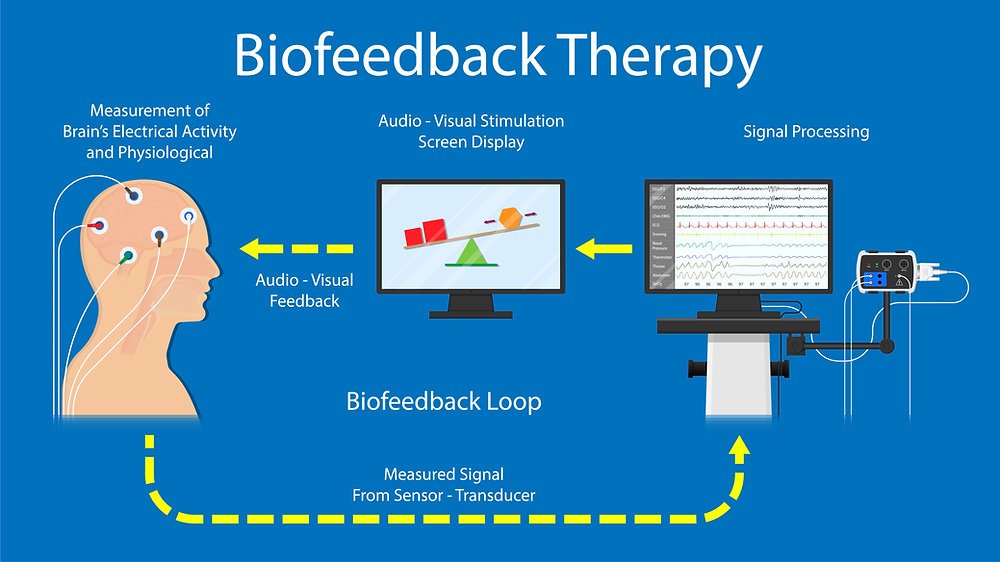
Biofeedback is a mind-body technique in which individuals learn to consciously control bodily processes that are usually involuntary or automatic, such as heart rate, muscle tension, skin temperature, and even brainwaves. At its core, biofeedback uses real-time feedback—often in the form of visual or auditory signals—to help one become aware of subtle physiological changes and to gain some level of voluntary control over them. Devices used in biofeedback can include electroencephalograms (EEG) for brainwave measures, electromyograms (EMG) for measuring muscle tension, skin conductance devices for stress-related changes in sweat gland activity, and other sensors for respiration rate, heart rate variability (HRV), or skin temperature. The principle behind biofeedback is that by providing immediate, tangible feedback of the body’s internal processes, individuals can learn to self-regulate and enhance physical, mental, and emotional well-being.
History of biofeedback
Biofeedback has evolved from a variety of scientific and philosophical traditions:
Early physiological studies (19th and early 20th centuries): The groundwork for biofeedback can be traced back to scientists studying physiology and the mechanisms of the nervous system. Ivan Pavlov, for instance, showed that physiological responses (such as salivation in dogs) could be conditioned, paving the way for a broader understanding of how the brain and body interact.
Technological advancements (1980s–Present): As technology advanced, so did the sophistication of biofeedback devices. The advent of personal computers, and later, wearable technologies enabled practitioners to provide real-time, user-friendly feedback and to integrate multimedia elements (like computer games) to enhance user engagement. Today, biofeedback encompasses not only traditional instruments but also emerging consumer-level devices (like smartwatches and other wearables) that measure heart rate variability, galvanic skin response, or brainwaves for wellness and performance enhancement.
Biofeedback mechanism and how this method helps our brain
Biofeedback’s mechanism is centered on the concept of operant conditioning—where feedback about a physiological function prompts the user to alter their internal states. When individuals receive immediate data on physiological processes, they learn, often through trial and error, how certain thoughts, behaviors, breathing patterns, or postural adjustments can bring about desired changes. Over time, these changes become more or less automatic and integrated into normal behavior.
Enhanced self-awareness: By providing insight into physiological and neurological patterns, biofeedback encourages a heightened self-awareness, enabling recognition of stress triggers and maladaptive patterns (like shallow breathing or muscle clenching).
Self-regulation: As individuals gain awareness, they learn specific strategies—such as progressive muscle relaxation, guided imagery, or slow breathing techniques—to regulate stress responses more effectively. This can lead to decreased sympathetic (fight-or-flight) activity and increased parasympathetic (rest-and-digest) activity in the autonomic nervous system.
Neuroplasticity: Biofeedback, especially EEG (neurofeedback), can influence neuroplasticity—the brain’s ability to reorganize itself. By reinforcing certain brainwave patterns, one can gradually improve cognitive functions, attention, and emotional regulation.
Stress and anxiety reduction: When people realize they can control their physiological responses, they tend to feel less helpless in the face of stress and anxiety. This empowerment can lead to improved mental health and better coping skills.
Applications of biofeedback
Biofeedback has diverse clinical and non-clinical applications
Stress and anxiety management
By learning to recognize early signs of physiological stress, individuals can use biofeedback to practice breathing techniques, guided relaxation, or mindfulness to lower heart rate and muscle tension.
Pain management
Techniques such as EMG biofeedback help patients with chronic pain conditions (e.g., low back pain, migraine headaches, temporomandibular joint syndrome) learn how to relax muscles and reduce body tension that contributes to pain.
Headache and migraine treatment
EMG and sometimes thermal biofeedback have been used extensively to help people identify tension and temperature fluctuations that might indicate an impending migraine, allowing them to take early steps to mitigate it (like guided relaxation).
Rehabilitation and motor control
In physical therapy, EMG biofeedback is used to help stroke survivors or patients recovering from orthopedic injuries relearn specific muscle activation patterns and coordination.
Blood pressure regulation
Some research indicates that certain heart rate variability (HRV) biofeedback techniques can assist in moderating blood pressure in individuals with hypertension.
Sleep disorders
Biofeedback may be used to train people to relax more effectively, thereby improving sleep onset and quality. EEG biofeedback (neurofeedback) protocols addressing brainwave dysregulation can help with insomnia.
ADHD and other neurodevelopmental conditions
Neurofeedback has been explored as a treatment modality for children and adults with attention deficit hyperactivity disorder (ADHD), aiming to enhance focus, attention, and executive function.
Peak performance and sports
Athletes, musicians, and corporate professionals sometimes use biofeedback to heighten concentration, reduce performance anxiety, and optimize energy levels.
Mental health
Clinicians incorporate biofeedback for managing anxiety disorders, depression, PTSD, and other conditions where self-regulation techniques can show benefits.
What happens in a biofeedback session?
A typical biofeedback session involves several components:
Headache and migraine treatment
EMG and sometimes thermal biofeedback have been used extensively to help people identify tension and temperature fluctuations that might indicate an impending migraine, allowing them to take early steps to mitigate it (like guided relaxation).
Sensor placement
Non-invasive sensors that measure heart rate, skin conductance, brainwave activity, muscle tension, or other signals are placed on the individual. Electrodes for EMG might be positioned over the muscle group targeted (e.g., forehead, shoulders, neck). For EEG-based neurofeedback, electrodes are placed according to standardized EEG placement locations on the scalp.
Baseline reading
The practitioner records baseline values for the chosen parameters, giving the individual and the practitioner an initial snapshot of the body’s state at rest or under mild stress.
Guided exercises
During the session, the practitioner will guide the individual through certain relaxation or cognitive techniques. These can involve diaphragmatic breathing, visualization, progressive muscle relaxation, mindfulness, or focusing on specific mental tasks. At the same time, the session includes feedback signals—often displayed on a computer screen or sometimes through sounds or animations—that change in real time based on the individual’s physiological responses.
Feedback interpretation
The user sees (or hears) when they have successfully altered their muscle tension, heart rate, or brainwave pattern, providing immediate reinforcement. Over repeated sessions, the person learns which actions—thoughts, posture changes, controlled breathing—effectively bring about the desired change.
Progressive skill-building
As sessions progress, individuals often become more adept at self-regulating these physiological states without as much reliance on the equipment. Practitioners track improvements over time, adjusting the biofeedback protocols as needed.
Homework and practice
Practitioners frequently give take-home exercises. This could include practicing relaxation techniques or mindfulness on a daily basis. The ultimate goal is for the individual to maintain the learned self-regulation skills during everyday life circumstances.